

AWS Partner Central 2.0 & ACE Pipeline Manager Transformation
Unifying a multi-billion dollar enterprise cloud ecosystem through predictive AI orchestration, high-velocity lead dispatch, and cross-platform design discipline across global partner networks.
Lead Product Designer
UX Strategist
Information Architecture
Design Systems Creation
User Research
Persona Development
Search & Discover y UX
Data Visualization
Cross-functional Collaboration.
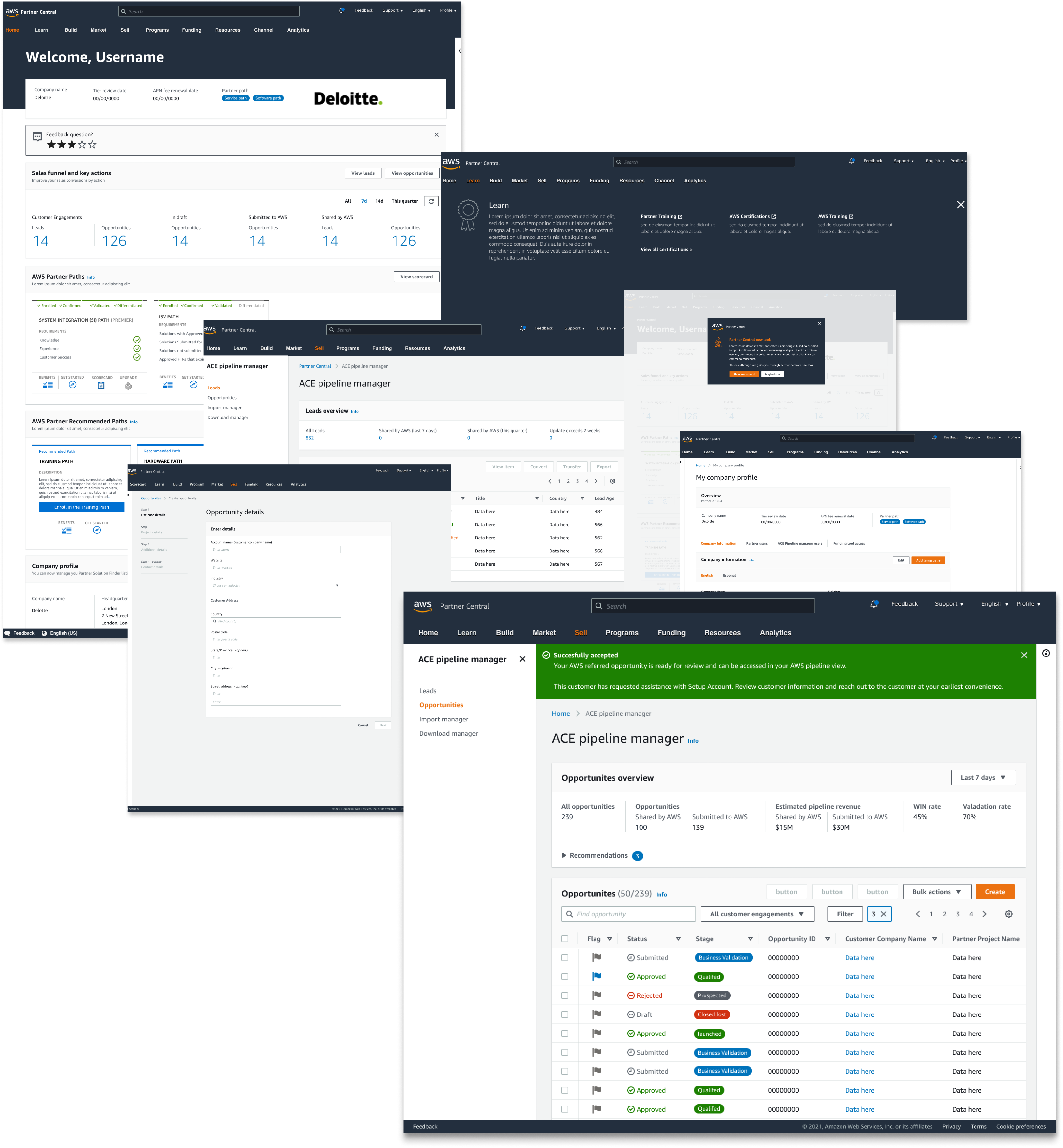
Finding the right one meant sorting through fragmented information, comparing capabilities manually, and making decisions without a clear way to judge partner fit.That created friction at exactly the wrong moment.I led the UX design for the AWS Customer Engagement (ACE) Pipeline Manager, with the goal of turning that fragmented process into a faster, more confident decision-making experience.
I started by talking with AWS sales and marketing users to understand how they actually searched for partners, what information mattered most, and where existing tools were slowing them down. Those insights shaped a new experience built around dynamic search, advanced filtering, and clear partner comparisons.
One of the biggest design challenges was helping users make sense of complex performance data. I designed scorecards and a confidence-scoring model that translated multiple signals—alignment, capability, execution, and quality—into something sales teams could quickly understand and act on.
The result was a tool that helped AWS teams move from “Who might be a good partner?” to “This is the right partner for this opportunity.”
Within the first eight months, the platform reached 5,171 users and 227K sessions, increased usage 17% year over year, and contributed to a 24% increase in partner-generated leads.
What started as a search problem became a better way for AWS teams to make faster, data-informed partner decisions.
How it came together
How I Think
With AWS Partner Central, I realized quickly that this wasn’t a screen problem. It was a system problem.
The platform had grown across programs, workflows, teams, and terminology. From AWS’s perspective, there was logic behind it. From a partner’s perspective, they were just trying to get something done.
So I started with the partner: What were they trying to accomplish, where were they getting stuck, and what did they need to know next?
That exposed a bigger issue: partners were being asked to understand too much about how AWS worked internally.My approach was to simplify the system around their goals understanding the workflows, dependencies, and decisions before getting deep into UI.
The principle became simple: a partner shouldn’t have to understand the organization behind the product just to use the product.
How I Work
I usually need to understand the whole system before I can confidently change one part of it.
At AWS, that meant working closely with product, engineering, research, and business teams to separate technical constraints, business requirements, program rules, and legacy decisions.
I mapped workflows across Partner Central to look for patterns instead of solving the same problem one page at a time. If users struggled with status across registration, opportunities, and other workflows, I wanted to understand whether the real issue was a broader platform pattern.
That’s the level I like to work at: I’ll get into the details of an interaction, but I’m always asking what it tells us about the larger system.
Prototyping helped me work through those decisions with the team early. My role was often finding the balance between what the business and technology required and how much of that complexity the partner actually needed to see.
How I got to my solution
One of the biggest realizations was that Partner Central wasn’t going to be fixed by one redesign. The platform was too large and too interconnected.
So I approached the work as a series of improvements that could also move the broader experience forward.Registration, ACE opportunities, and partner discovery were different problems, but they kept exposing the same need: better context.
Where am I? What does this mean? What do I need to do? What happens next?
That became a thread across my work, along with making navigation, terminology, status, and interaction patterns more consistent. The goal wasn’t to remove AWS’s complexity. It was to be intentional about where that complexity lived.
Some complexity belongs in the system. Very little of it should become the user’s problem.